Monday, February 3, 2014

Deer Carcass on the Ice - 1/13/14 - Written by Mike LaDue


Where would we be without our weather? It promotes conversation between old friends and unknown acquaintances. “Nice day, (they say) it is going to get colder soon, so we had better enjoy it while it lasts.” Every individual has their favorite kind of day, related to and dependent on the weather. Weather can provide some of natures most exhilarating experiences and often one never has to leave home to be immersed. This time of year we can loose power or be trapped by mounds of snow. Many of us have had to endure a sheet of ice, which has yet to dwindle. Ice has coated all of the fields, lawns and driveways. Just getting to an automobile requires nimble steps. I cannot use my driveway without ice creepers, these old bones would not fare well, from a slip and slide tumble.
This past week, the river has seen its share of enhanced and varied weather events. Tuesday a lake effect storm threatened to dump up to two feet of snow. The schools were closed and the wind was a wicked nuisance. We did not get a lot of snow along the river, but what did tumble down, kept a tumbling along at a good clip. There were times when I looked out of the windows into an opaque curtain of white. Birds were stacked up in a cedar tree out of the wind, awaiting a chance to feed. Each time the snow cleared they fluttered down to eat at the feeder. It was the most birds that I have seen at one time, this season. Pickings have gotten slim for all of the wildlife and each of them endure in their own fashion.
Wednesday it was clear and cold, with blue skies dominating the day. I used my field glasses to scope out the river and three tiny dots, moving from Carleton Island. The dots were three whitetail deer on the ice, moving to the east. I can not say they were doing much stepping; it was more of a sliding effort. In an instant they huddled together almost forming a circle. The group was hundreds of yards from the island when a lone coyote came strolling along. The loner was moving to the west and took a slight interest in the deer. It only paused for a few seconds to dismiss the idea of running the deer down. The deer were a good distance from it. Had this coyote been part of a pack, the deer would have all been in peril. Once the coyote vanished onto the island, the deer moved on. The deer moved down river along Wolfe Island, still taking ginger steps on the glassy surface.
Later that morning, close to noon I received a phone call from a neighbor; “Mike are you home? There is a deer with a broken leg on the river in front of your cabin. What can we do? It keeps trying to get up and it can’t move more than a step.” I volunteered to call the DEC and see if a conservation officer could come and dispatch the deer. The officer I called was near Hounsfield and I told him of the situation. Mind you the lake effect snow was nowhere to be seen (here), but it was still pilling up to the south. The officer responded to my request; “I have been told not to go anywhere if it is not an emergency. I have two feet of snow in the driveway and its still coming down. I don’t consider dispatching a deer an emergency… in this kind of weather. I’ll see what I can do tomorrow when it clears up.” I did not savor the idea of that deer having to be eaten alive and asked if there was anyone else locally to call. “There is one other officer; he may be able to get over to you. Give me you’re address and I’ll call him. I can’t make any promises”. I thanked him for his effort and told him that I understood his situation. The deer was going be on its own, in the hands of nature.
Before nightfall I could see that the deer lay with its head facing the shoreline, 200 yards away. A rear leg pointed to the west, while a front leg pointed east. Its glassed eyes were open and there was no movement. At least it had given up the ghost undisturbed. Now it belonged to the river and all of the predators. I wondered if the coyotes would find it overnight or if it would be there for weeks, drawing the attention of raptors. Thursday morning the deer was still intact and undisturbed. The day was bright (once again) and the deer carcass would stand out like a ‘McDonalds’ along an interstate. If there were any eagles, crows or ravens, they would be drawn to one bountiful feast. The unpleasant methodic demise of one creature often results in the thriving of others. Nature deals with over population in what seems like cruel drastic fashion. She culls the numbers according to what the land can bare and she also maintains an efficient clean up crew.
I shared some fresh perch with neighbors Thursday (as I intend to get many more, before winters end). When I returned home I saw three mature bald eagles around the deer. They approached the deer cautiously making sure that it was not alive. Two of them began their work around the head and stood on their meal as they tore away at the hide. The third stood atop the hind quarters and used its beak to break off flesh. I made my way outside to get a photograph. They each stopped eating and focused on me. I was a long ways from being too close, but they took to the air none the less. I got one photo of them leaving. The eagles each flew in different directions to land on the river ice. They refused to come back while I was in sight. It makes me wonder how often they are still harassed and even shot at by poachers.
Friday I took part in the annual eagle survey, done by the Department of the Interior. I got up and out to over look the deer carcass, as daylight broke. It began to snow and visibility was poor. Starlings and some late season robins added a much missed song of cheer to the morning air. I had high anticipation of seeing a good number of eagles to count. I spent over an hour with snow pelting the back of my neck. In the distance, in a tree on Carleton Island, I saw two eagles on roost. It was hazy due to the snow fall, but the size and stature of the birds confirmed what they were. At least I got to see two for the survey.
Sunday morning I went out early again to watch the process on the deer. A lone mature eagle worked over the deer, until it had a full belly and cascaded off. Soon after that a large black northern raven, caught sight of the deer. It landed on the ice and slowly approached the deer, as the eagles had done before. If you have never seen one of these jet black birds, they are large and impressive. I could not believe how big it was standing on the deer! The raven has retuned a number of times to do natures work, as a member of the clean-up crew. A pair of crows were on the deer, when I went down to my boathouse yesterday, to check on my Lyman.
Earlier in the week I had to get into the boathouse to retrieve my electric fillet knife. It was blowing and snowing at the time. The boat was covered in eight inches of snow that mounded up on the canvas cover. The wind was blowing in under the doors and even the cobwebs wore the snow. The dangling looped strands looked like fine lace bridging one wall to the other. Sunday I was worried that the melting snow would become ice and put too much stress on the canvas. I took a broom and shuffled the snow off, revealing the bright blue canvas. I rubbed the gunnels of the old boat and told her; “It won’t be long now, were halfway there. Less than ninety days to go and the river will be ours again”…

Wednesday, December 11, 2013

Island Deer Hunt - 11/13/13 - Written by Mike LaDue


An Outdoorsman’s view on the River              
This week I am going to share an experience that I never dreamed of having. Over the past few years I have become friends with two couples on an Island. They are neighbors and have adjoining property. The parcels are directly in front of the shipping channel and the view is splendid. I had been invited to the island in the past to walk its interior. There were song birds, herons and even eagles raising a brood there. Also there just happens to be a few deer present, as well as coyote’s.
As summer came to a close, I was handed a permission slip to access the island… to hunt. “Don’t forget to bring you’re camera, you never know what you will see here. You are welcome to come over anytime.” The sincerity and generosity of the invitation meant a great deal to me. I know that they each enjoy watching deer during the summer. Most deer watchers, who do not hunt, are generally skeptical. Hunters are often seen as blood thirsty killers instead of conservationists. I’ll not argue the fact that there are some hunters, who just go out to shoot, stomp and disregard land owners. I have known very few in that class, all of my acquaintances are highly ethical. Our fathers drilled in the importance of safety first and shooting last. We learned that a day in the woods is a privileged event. Those days were only possible because the land owners trusted us. That trust was earned by showing overwhelming respect.
I have often wondered what it would be like to hunt on an island. I know that Native Americans used this same island when it was still a wilderness. They had camps there, where they gathered food, grew gardens and survived off of the land. Just the thought of walking across those same faded foot prints put me into a dream state. Imagine having a partial island to wander. There would be acres of trees, brush and open fields overlooking our marvelous river. Yes, I was as excited as I was thankful for this rare opportunity.
As you may know the river in the fall is often belligerent. Windy days dominate and calm days are scarce. As excited as I was, I had to wait for a calm day with a soft breeze, to cross to the Island. Some days started out promising, but when I checked the incoming weather, the waiting had to continue. Usually by 9:00 AM the wind returned to churn the river top and create white caped waves. Finally on the 5th of November a southern breeze blew and my day to experience an Island hunt was at hand. I spent an hour loading my small puddle jumper boat with equipment. I collected a life preserver, seat cushion, rope, deer cart, gun, rain gear, backpack, water and a lunch. I double checked everything and then added some matches just in case I had to spend the night. You never know, the river can change in an instant. Being on an island in November without a fire, would not be wise.
I had a broad smile on my face, during the journey over. I took my time to enjoy the rolling waves, listening to the water splash off of the hull. The first craft I saw was a Coast Guard boat heading up-river in the channel. The second one was anchored with a string of decoys in front of it. They were duck hunters with a boat covered in camouflage. It looked like a very comfortable proposition to hunt safely from. With a setup like that they could withstand some harsh weather without ever getting wet. That was not a worry on this day; it was bright, sunny and dry.
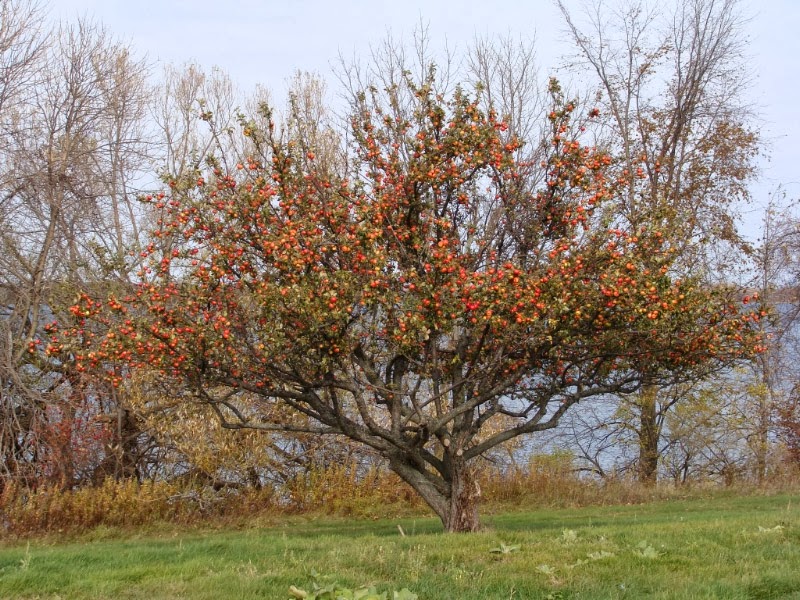
I disembarked, stretched and looked around at the wide open space. The Island of summer had faded to browns with remnants of color clinging to scattered trees. A lone apple tree caught my eye. The fruit was like a burst of life with yellows, reds and gold shinning in the sun. I could not help it; I reached up for one of the perfectly round apples and took a bite. You never know how an heirloom apple is going to taste. This one tasted exactly like the apples I remember eating along the railroad tracks, where I grew up. I stowed another in my backpack for my bride to enjoy.
I followed the shoreline from the apple tree and up over a small gully surrounded by willow trees. The cover was dense and I could see where deer had been bedded. My steps were silenced by soft grass and my progress slow. I wanted to see if I could get close to a bedded deer without alarming it. My slow walk took me through a large field loaded with goldenrod. I paused to admire the river. The expanse of blue water was rippled with a shimmering glow from the sun aloft. As I turned to begin a climb up a ridge, a doe jumped from her bed and raced up the incline. She stopped to look back at me from a high advantage point. I sat still and waited for her curiosity to wane. She stepped out of sight as she wandered back down the ridge, into safe cover.
I followed the route that the deer took and ended up on the high spot overlooking the river. A large rock was conveniently deposited by glacial activity centuries ago, right on the top. I decided to sit there and have lunch. Many thoughts went through my mind as I enjoyed a November picnic, all alone. This rock may have had a Native American taking a break under the same sun, many years ago. The island would have been full of mature timber and the view much different. How high were those trees and how old were they? Did the natives have to contend with cougars or wolves? I’ll bet that there were not too many 57 year old natives traipsing about. I would have been considered an elder, long in the tooth as it were. It is much more likely that I would have been a bag of bleached bones, long forgotten.
The sun came and went as clouds drifted along. Several times I heard the whistle of a train in Canada. Again I was reminded of the old Railroad that I wandered as an adventurous youth. There were times back then when I was a train robber, an Indian, or a colonist settling the new world. My spirit intertwined with the past often, as history was a consummate friend. This spot where I sat was a friendly place, a good place, one of a kind. The rock became irritated with me and became uncomfortable. I stood to stretch and my feet lead me along the ridge further.
A stand of sumac was on the top of the ridge. There were four deer beds, where the grass had been laid flat by slumbering bodies. There was no way of knowing if I had disturbed them or if they had been there a few days before. I silently walked down the slope to peer into a clear area, under some thorn apple trees. Scanning the area I could see nothing more than weeds and brush. I used a call to make three soft buck grunts. A big doe rose from the earth as if a magician had just conjured her up. She stood and stretched for just a moment, only forty yards away. I had to make a quick decision. Her thick neck held her head high above the weeds. This doe would be a burden to try and get off of the island; she looked to be over two hundred pounds. This was only the second deer that I have seen of that size, in all of my years.
She would be the last deer that I saw on this outing. I spent another hour walking and sitting in a grove of hickory trees. A lone woodpecker hammered and clamored up the scaly bark of a hickory, next to me. A flock of blue jays cascaded through the grove chattering and gathering nuts. The leafless trees in front of me opened up a grand view of the river and a passing ship. The sun was beginning to settle into the trees and daylight was slipping away. I walked out of the woods at a normal pace, unconcerned at spooking deer any further. I spent four and a half hours on this island. Wandering about in nature is always rewarding… this day was exceptional.

Thursday, October 17, 2013

Nice Autumn Weekend - Written by Mike LaDue - 09/30/13


Autumn has returned serenity to the river once again. For the most part I have the river to myself, along with the migrating birds. The weekends still have a fair number of visitors, savoring some extra days on the water. This past weekend was ‘summer like’ and Saturday brought out plenty of boaters and anglers. Boats of all kinds either sizzled across the river or crept, according to the whims of the operators. Everyone finds pleasure in making one last wake of the season.
Friday I gave it another try for walleye off of the Ironman… until the wind changed the plan. I noticed small mouth bass jumping near the old ‘Light keepers’ house on Carleton island. This prompted me to switch my bait to a J-7 Rapala from a spoon. I trolled into the wind approaching the area where I had seen the bass (feeding on minnows). A fish of sizable quality took the jointed bait and ran in the opposite direction. It stripped half of my line and I expected to see a tail dancing Muskie. The fish in question decided to submit to the ‘thing’ dragging its jaw and came to the Lyman. She was a 36” pike and had the barbless lure hooked in two spots.
When I pulled out the first hook she slapped her tail and gave me a bath. I was in an area out of the wind and appreciated the cool water on my face. Her last effort was a short run to the bottom and she bobbed back up within reach. I slid my Pap’s pliers under her jaw and released the second hook. She finally realized that she was no longer attached to the strange creature above her. I can only imagine her perception of that experience and her interpretation of what just happened. In a somewhat dignified motion she used her tail to return to her lair. Her body motion reminded me of a child’s hand playing with the wind, from an open car window. 
I moved down river to fish for perch and the bite was light. There were more geese in the air than there were fish under me. I have to say that at least two thousand honkers passed over head going to Canada. There was a steady stream of flock after flock for over an hour. One flock had a snow goose leading them and I was surprised to see one (of those) in September. All but that one snow goose are probably local birds who have merged. I think that our local geese have united with the local geese across the channel. Field corn has recently been harvested on our side of the river; they eat here and return to Canada to rest. That’s my theory… when the fishing is slow I have time to think, dangerous.
Evenings have drawn me to the river to watch the geese return as dusk settles in. They fly in from our mainland and follow the orange/red glow left by a vanishing sun. Their black silhouettes are like shadow paintings in flight. Waves of them at varied heights make chattering honks, to the ones already at roost. The river surface appears to be on fire each evening while rolling waves pulsate as if carrying glowing ambers. The geese fly over Feather bed shoal with the flashing eyes of the wind turbines, blinking at their return. In the stillness I am inundated with tiny white bugs who attach to me and the boat. Soon minnows notice the easy meal on the river surface. They rise to snatch a bug leaving a circular pool of red rimmed beauty.
Saturday afternoon was as delightful a day as one could wish for. The air was warm, the sun high and the river calm. I went out to sit and enjoy the day claiming that I was going to fish. I did not care a lick about catching a thing, I just found a spot kicked my feet up on the gunnels and relaxed. Soon my shirt was off and the sun was working on burning my legs and arms. A lawn was being cut on the island near me. The sweet aroma of cut green grass will soon be lost. Two boats came down river and they were associates. They obviously were out to drink up this sensational bonus afternoon. The laughter, joking and singing soon surrounded me.
“Hey, Mike LaDue!” Waving arms and hands were in the air, gestures were made to mimic my casual fishing effort. They knew me but I did not recognize them, as they circled the Lyman. I could not help but laugh at the festive time they were having. I appreciate them acknowledging and including me in their day. I watched as they motored casually down river, with without a care in the world. I was not the only one who enjoys the river for what she is and what she offers. It is a big pie and there are plenty of pieces for everyone to share.
Around 2:00 PM I began to feel the sunburn and took a ride to cool off. I stood up and let the wind rustle the remaining few hairs I have left on my head. I was going to head home and call it a day, but how could I leave? It was just too dang nice to walk away from a day like this. I spied a spot where I had not fished for perch since spring. A slight breeze worked my jig for me as I was too last to jig myself. With my feet up on the gunnels again, I began to catch one perch after another. Suddenly I became interested in fishing. These perch were not little ‘bait’ grabbers but big hump backs. On my first pass I caught four that were 10” and as scrappy as they come. A jet ski went past me and a pair of women hollered out my name “Mike LaDue!” I acknowledged them with a wave.
My eventful day of well wishers, relaxation and over exposure to the sun was suspended at 4:00 PM. I had a stringer of 20 perch to fillet, diner to cook and a sunset to catch. I may not look busy to the casual onlooker; some might even say that I have too much time to spend on the river. A wealthy person is one who can achieve satisfaction with the simple luxuries in life; jus call me Rocker-fella.

Friday, August 2, 2013

Fledgling Birds - 07/07/13 - Written by Mike LaDue


While in the garden pulling weeds or harvesting leafy greens, I have noticed a plethora of young birds. Robins, grackles, starlings, morning doves and the local nest of Merlin’s have fledged. It is enjoyable to watch the smaller bird’s line up around our feeder and wait for seed. You would think that once the young fledge, they could fend for themselves (more) efficiently. No, the caretaking is far from over for the adult birds. The parents are still responsible for feeding the young, as well as for their safety.
Growing birds are far more vocal than the average child. They squawk and complain even while the seeds are being beaked right into their mouths. It takes days for the pea brained complainers to realize that they are capable of doing the same thing on their own. Even though they do have a small brain, I’ll give them credit for knowing when it is time to leave home. Finding out that they can fly must be a liberating experience. They need no training, no learners permit or a class to show them how. It is a leap of faith reinforced by parents coaxing or the witnessing of fellow siblings making the plunge. If a human child had the same chance I wonder if they would ever be seen again.
There are two predators that the young flyers have to be aware of in the neighborhood. The first is, as in many other neighborhoods, the outside cat. The second less common predator is the Merlin (falcons) that are now feeding their fledged young. The Merlin’s have been lively with chatter all spring, but now that the young are flying the, noise is twofold. My bride watched one of the young ones yesterday take a meal from the sky and light onto a bare branch. A second young Merlin decided that sharing the meal would be a great idea. It came to join its sibling and was promptly admonished and chased away. Sharing was probably fine while they cohabitated in the nest and food came along all by itself. That falcon learned the rewards of its labor and was not going to share those efforts with one who does not even try. Humans may see that as a cruel rule, but it is one that makes being self-sufficient mandatory.
Friends from the river invited my bride and me to take a hike around the island where they spend weekends. We walked the trails and enjoyed watching songbirds and ripening wild raspberries. There was a relieving shade under the tall oaks standing in woods, and some of those (trees) are well over a hundred years old. It was like walking in the wilderness that once surrounded this river. How refreshing to hear nothing but nature and seeing the lack of man’s interference with it. We were in for an unexpected treat when they told us that a rookery of blue herons occupy a section of those woods.


Jane said; “Shall we take them to see the rookery of herons?” That statement stopped me in my tracks; “I have not been close to a heron rookery since I was ten years old. My Pap and I used to fish around Iron side Island and that was as close as I ever got to them. I’d like nothing more than to get under their nests and listen to them.” Jane’s husband Mike was leading our walk and said; “It is like going to some prehistoric place. You won’t believe the racket that they make. When we first came here and listened to them during the night we had no idea what they were.” He led us over hills and through the woods to a slight valley.
I could smell them long before I saw or heard them. The air over the island carried the aroma and I was reminded of my days cleaning out chicken coops. Mike was correct, the herons screeching and squawking was eerie. The mature birds flew in with fish to feed the young and as they approached the immature herons cried for attention. The long gangly adult birds put on the brakes, to land on foliage covered branches. Swooping sounds of faltering wing beats added to the ever present chatter. The returning herons cast shadows over the tree tops, before stretching out two long legs to grasp a solid perch. Whitewashed chalky scat covered the ground below each nest. We were there… under the rookery.
Three deer slipped through the woods as my bride and I took gingerly footsteps around the scat. We craned our heads to the sky to see several nests high above the ground. Immature herons stood on piles of sticks sewn together by the long bills of their parents. Others ventured out beyond the nest to stand and stare into the air, like forlorn children waiting for a school bus. It was difficult to photograph, the birds blended into the sky and foliage almost becoming transparent. I managed to focus on a tree where two adults pandered to the hunger of an off spring. At no time could I get all of them completely into the shot but it was close.
When a heron stands in just the right direction it looks like a piece of vertical plywood standing on its side, with two eyeballs attached. That’s what makes them efficient at catching fish, lack of movement and an invisible forward profile. The young in the trees already had that down; they were hard to pick out (if they were not moving). Last week my bride just happened to see a heron fly past with a chipmunk hanging from its bill. I have seen herons in ponds snatching frogs and in ditches taking pollywogs. If they are able to spear a chipmunk you know just how fast they can strike!
 One of the trees had a number of horizontal branches and it held six different nests. You can imagine what the earth looked like under that tree! I have no estimate on how many heron were in that pungent lively rookery. We backed out and left the area to the community of original residents, who for centuries never saw a human.

A hundred years has changed this river in many ways. I have only known her for the last fifty. Of all of my experiences in nature along her shores, this was the first time that I traversed what was once called a wilderness. I found that it is not only a sanctuary for herons; it was also a sanctuary for my spirit. I thank our friends for sharing this secluded seductive section of the river. It thrives in a different time, but in the same place as a resilient reminder to the rivers importance. We are not the only species and far from the only beneficiaries of her unique ecosystem.